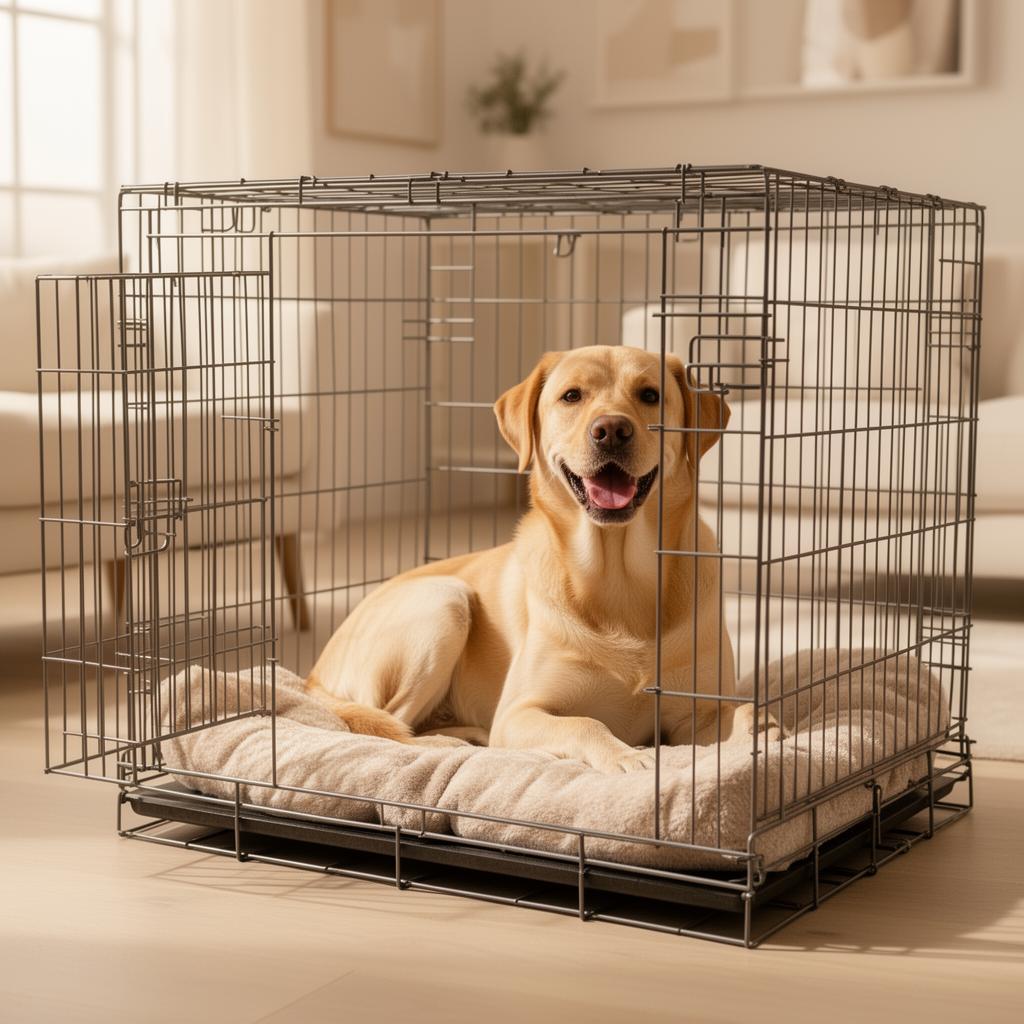
What size crate does your dog need?
Pick the method you have on hand — weight, breed, or a tape measure. We size for a crate that lets your dog stand, turn, and stretch out fully.
Engineered for dogs around 45 lb.
Standard crate sizes
| Size | Length | Max dog weight |
|---|---|---|
| 18" | 18 in | Up to 15 lb |
| 22" | 22 in | Up to 25 lb |
| 24" | 24 in | Up to 30 lb |
| 30" | 30 in | Up to 40 lb |
| 36" | 36 in | Up to 70 lb |
| 42" | 42 in | Up to 90 lb |
| 48" | 48 in | Up to 110 lb |
| 54" | 54 in | 110+ lb |
How the crate size calculator actually works — and why the number matters
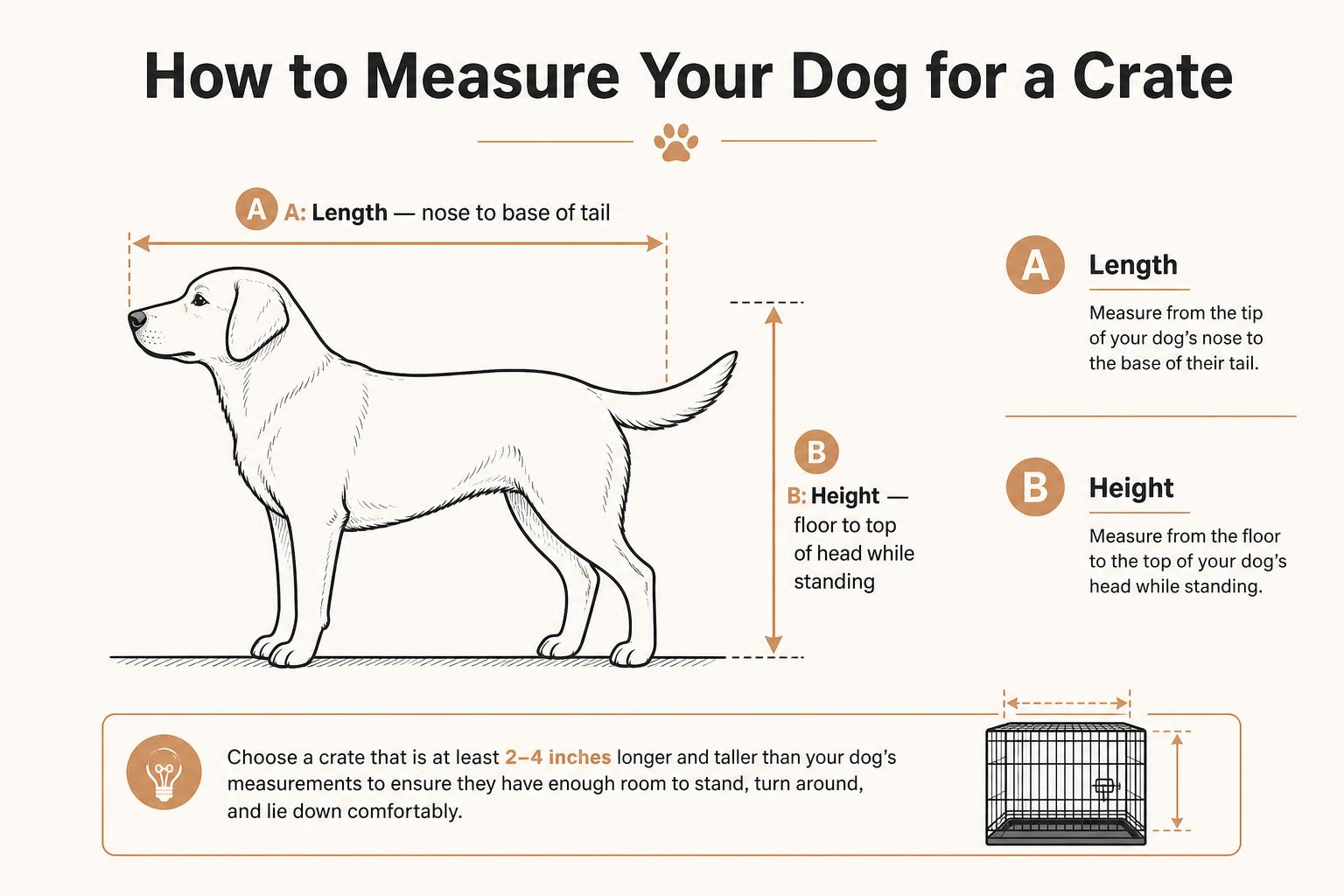
Every crate size on this site comes from the same three-part formula, applied consistently whether you're sizing by weight, by breed, or by direct measurement. Body length (nose to the base of the tail) plus 4 inches gives the minimum crate length. Standing height (floor to the top of the head or ears) plus 2 inches gives the minimum crate height. We then round up to the next standard manufactured size — 18, 22, 24, 30, 36, 42, 48, or 54 inches long — because those are the crates you can actually buy. Everything else, including the breed database and the weight-to-dimensions table, is a shortcut to those two measurements.
The reason for the buffers is behavioral, not decorative. A dog needs to stand without ducking, turn a full circle, and lie flat on their side; the 4-inch length and 2-inch height buffers are the smallest tolerances that let a typical dog do all three comfortably. Undersize the crate and you get hunched posture, restless nights, and — over months — real musculoskeletal strain, especially in long-backed breeds like Dachshunds and Basset Hounds. Oversize it for a puppy and you defeat the den instinct that makes crate training work in the first place: given room to walk three steps away from their bed, most puppies will pick one corner as the toilet and stop learning bladder control.
This is also why the calculator prefers weight or measurement over breed name. Breed weight ranges are wide — a female Labrador at 55 lb and a male at 80 lb are both "Labs" but often need different crate sizes — and body proportions vary even more. A 45 lb Border Collie and a 45 lb Basset Hound belong to different crate sizes because their body lengths are not the same. Manufacturer sizing charts, which map weight bands directly to crate sizes, cannot see that difference. Ours does, because the underlying calculation is always length plus height first, and weight is only a proxy for those.
Getting the size right matters more than most owners realize. The crate is the room your dog sleeps in every night for the next 10 to 15 years, the container they travel in, and — for puppies — the single most important house-training tool you own. A crate that is the wrong size does not just feel wrong; it teaches the wrong things. It teaches a puppy that indoor elimination is negotiable, teaches an adult dog that the crate is a cramped punishment, and teaches an anxious dog that being confined means being trapped. A correctly sized crate does the opposite: it becomes a safe space the dog chooses voluntarily. That is the outcome the calculator is aimed at, not the number itself.
For the reasoning behind specific decisions — divider placement, brachycephalic ventilation, escape-artist materials, placement, and more — see the editorial essays. For step-by-step training and buying guides, see the resource hub.
Crate sizing questions
How is the correct crate size calculated?+
Crate length equals your dog's body length (nose to tail base) plus about 4 inches. Crate height equals your dog's standing height (floor to top of head or ears) plus about 2 inches. We then round up to the next standard manufactured size — 18, 22, 24, 30, 36, 42, 48, or 54 inches long — so you can actually buy the crate. The calculator does this from either a weight, a breed, or direct measurements.
Is it better to size a crate up or down?+
For adult dogs, size up when your dog is within 2 inches of the next size, has a long back (Dachshund, Basset, Corgi), or is a brachycephalic breed that benefits from extra airflow. Size down — or use a divider — for puppies who are still house-training, because a too-large crate weakens the den instinct that keeps them clean.
Why does the calculator ask about weight instead of just breed?+
Breed weight ranges are wide. A female Labrador at 55 lb and a male at 80 lb are both 'Labs' but often land in different crate sizes. Weight is a more reliable proxy for body dimensions than breed name alone, which is why the calculator uses breed only as a starting estimate and lets you refine with weight or direct measurement.
Do the manufacturer sizing charts already handle this?+
Most manufacturer charts assign a size to a weight range, but they were designed decades ago around a small number of common breeds and do not account for body-length variation. Two dogs at 45 lb — a Border Collie and a Basset Hound — need different crate lengths, and a weight-only chart cannot see that. Our calculator uses length plus height, not weight alone.
Do I really need to measure my dog, or is the breed calculator enough?+
The breed calculator is accurate for most typical adults, but you should always measure before buying. Bloodline, sex, and mixed heritage produce real variation, and the crate should fit your specific dog. If your dog measures within 2 inches of a size boundary, buy the larger crate.
Five in-depth travel guides
Airline crate requirements for 2026, real crash-safety physics for the car, the full packing list, hotel-room crating rules, and a 4-week pre-trip training plan for dogs who have never traveled.
- Air Travel · 12 min read
Airline crate requirements for dogs in 2026 — what's changed and what gets you rejected at check-in
The 2025 IATA CR-1 Edition 51 changes, the five structural checks airline agents actually verify, and the airline-by-airline table for in-cabin vs cargo travel in 2026.
- Car Travel · 11 min read
Dog crate safety in the car — crash testing, sizing, and why 'airline approved' does not mean car safe
The physics of vehicle crashes, why IATA-approved crates fail crash tests, the Center for Pet Safety ratings, and how to size and secure a crate for real road-trip safety.
- Preparation · 9 min read
The complete dog travel packing list — what to bring, what to leave home, and how to organize it by trip type
A categorized, printable packing list for dog travel — documents, crate and gear, food and water, health and safety — with a comparison table by trip type (flight, road trip, hotel).
- Accommodation · 9 min read
Leaving your dog in a hotel crate — what's actually allowed and how to make it work
How hotel pet policies really work, why the crate is the difference between being able to leave the room and being stuck, room setup, barking prevention, and welfare time limits.
- Training · 10 min read
How to crate-train your dog for travel — a 4-week plan before your first trip
A week-by-week countdown to travel day for owners whose dog dislikes or has never used a travel crate. Introduction, duration, distance, and a full rehearsal week.
Browse by breed
- Akita
- Australian shepherd
- Basset hound
- Beagle
- Bernese mountain dog
- Border collie
- Boston terrier
- Boxer
- Bulldog (English)
- Cavalier King Charles spaniel
- Chihuahua
- Cocker spaniel
- Corgi (Pembroke Welsh)
- Dachshund (miniature)
- Doberman pinscher
- French bulldog
- German shepherd
- Golden retriever
- Great Dane
- Great Pyrenees
- Irish wolfhound
- Labrador retriever
- Maltese
- Mastiff (English)
- Miniature schnauzer
- Newfoundland
- Papillon
- Pomeranian
- Pug
- Rottweiler
- Saint Bernard
- Shetland sheepdog
- Shih Tzu
- Siberian husky
- Standard poodle
- Toy poodle
- Vizsla
- Weimaraner
- Yorkshire terrier